



Recently, the research outcomes of SR-LLM (Symbolic Regression Large Language Model), jointly developed by MUST as a core institution, together with Tsinghua University, the Institute of Automation at the Chinese Academy of Sciences, the University of Southern California (USA), the University of Cambridge (UK), and other partners, have been published in PNAS (Proceedings of the National Academy of Sciences of the United States of America). This work provides an innovative approach and foundation for the intelligent testing, control, and optimization of robots in complex and dynamic environments, alongside autonomous unmanned systems. It addresses critical deployment bottlenecks in real-world settings, providing a methodological reference for the safe, large-scale application of next-generation unmanned systems.
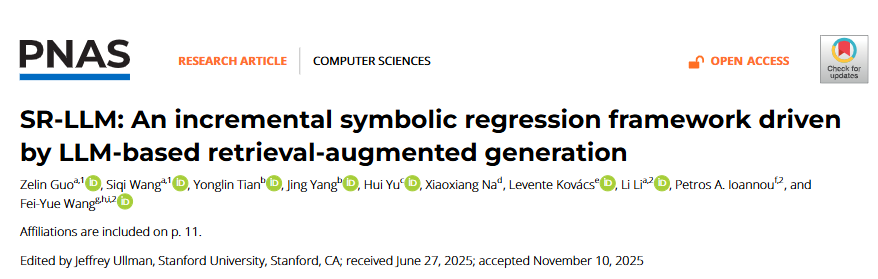
The collaborative research on SR-LLM completed by institutions has been published in the international journal PNAS
During March 30 to April 1, 2026, the Symposium on Deploying SR-LLM for Next-Generation Unmanned Systems was held in hybrid format (online and offline) in Macao. The event was chaired by Professor Qiao Sun, Dean of the FIE, MUST, Professors Fei-Yue Wang, Zitian Han, Naiqi Wu, Yisheng Lyu, Mengzhen Kang, and others attended the symposium. Experts from China, the US, Canada, the UK, Hungary, and other countries gathered to discuss the technological value, deployment pathways, and scenario adaptation of SR-LLM, with a focus on the low-altitude economy sector and the development frameworks of LaSEE (Low-altitude Space Economy and Ecology) and CiSEE (Circular-in-Situ Economy and Ecology). The symposium built international consensus to empower unmanned vehicle management, public mobility services, and intelligent logistics.
SR-LLM offers a methodological reference for critical industry pain points: long-standing challenges in unmanned systems operating in open environments, such as difficult scene representation, disjointed virtual-real simulation, inefficient validation, and unclosed testing loops. It points to a workflow that links scene modeling, intelligent simulation, quantitative task verification, and full-cycle feedback. By integrating symbolic regression with large language model-based retrieval-augmented generation, SR-LLM is relevant to highly dynamic and interactive open scenarios, helps researchers approach the long-tail problem in autonomous driving, informs the handling of emergency conditions and decision-making safety for unmanned vehicles, and supports the transition from laboratory research toward real-world application.
Three core achievements were released at the symposium: a special report on SR technologies, the original PNAS research paper, and an industry review report. These outputs clarify the practical deployment roadmap and future R&D priorities of SR-LLM from three dimensions: fundamental principles, theoretical architecture, and industrial applications.
Global experts reached a consensus: unmanned systems have entered a critical stage of technology-to-industry translation, and the methodology behind SR-LLM offers a promising route for safe management and control in complex scenarios. Integrated with the LaSEE and CiSEE frameworks, this methodological line of work can be extended to the governance of low-altitude unmanned systems, connecting the technological chains of low-altitude economy, circular development, and personalized applications.
Scholars from the University of California, Los Angeles (USA), the University of Southern California (USA), the University of Victoria (Canada), the University of Cambridge (UK), the University of Glasgow (UK), and Óbuda University (Hungary) participated in the discussions. The symposium built an international platform for cutting-edge exchanges and industry-academia-research collaborative innovation. It contributed to the technical foundation for safety in unmanned mobility and logistics and opened new avenues for integrated innovation in the low-altitude economy, supporting the global deployment of unmanned system technologies and the high-quality development of the intelligent industry.

