



The Faculty of Innovation Engineering at the Macau University of Science and Technology held the sixth session of its 2026/27 Distinguished Lecture Series on 6 November 2026. The event featured Dr. Stéphane Grumbach, Research Director at the French Institute for Research in Digital Science and Technology (INRIA) and an internationally renowned expert in complex systems science, who delivered a lecture titled “Complexity Surge, a Planetary Challenge.” During the lecture, he shared profound insights into contemporary global development trends and the governance of complex systems.
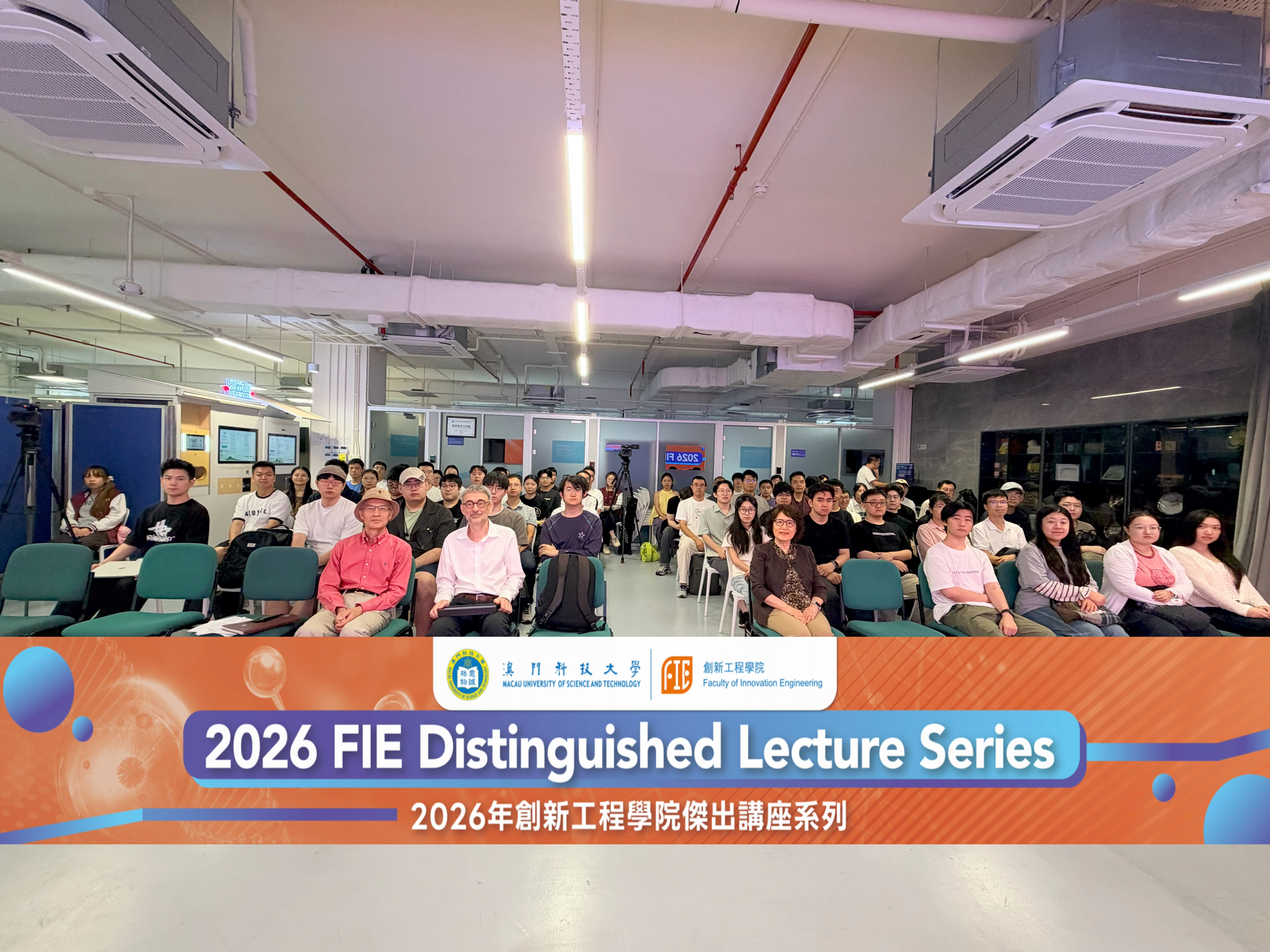
Group photo of participants
Dr. Stéphane Grumbach has devoted his career to research on complex systems, digital transformation, and global governance. He previously served as Director of the Lyon Institute for Complex Systems in France and taught for many years at Sciences Po. He has conducted academic research and collaborations in the United States, Canada, Italy, Japan, and China, establishing a strong foundation for examining how digital technologies shape the future of human society.
As population growth, rapid technological advancement, deepening global interconnectedness, and increasing human pressure on planetary boundaries continue to reshape the world, societies are facing an unprecedented surge in complexity. The lecture examined a range of critical contemporary issues, including global environmental change, the rise of autonomous machines and intelligent systems, governance challenges, and geopolitical competition. It explored how human societies can better understand and respond to increasingly complex challenges in an interdependent world.
According to Dr. Stéphane Grumbach, growing complexity has become a defining characteristic of modern society, contributing to governance failures and the persistent gap between real-world dynamics and institutional arrangements. Drawing on the theory of complex systems, the lecture introduced key concepts such as long-distance interdependence, distributed memory and control, self-organization, feedback loops, nonlinear behavior, and critical tipping points. These perspectives provided participants with a deeper understanding of the mechanisms underlying the functioning of contemporary societies.
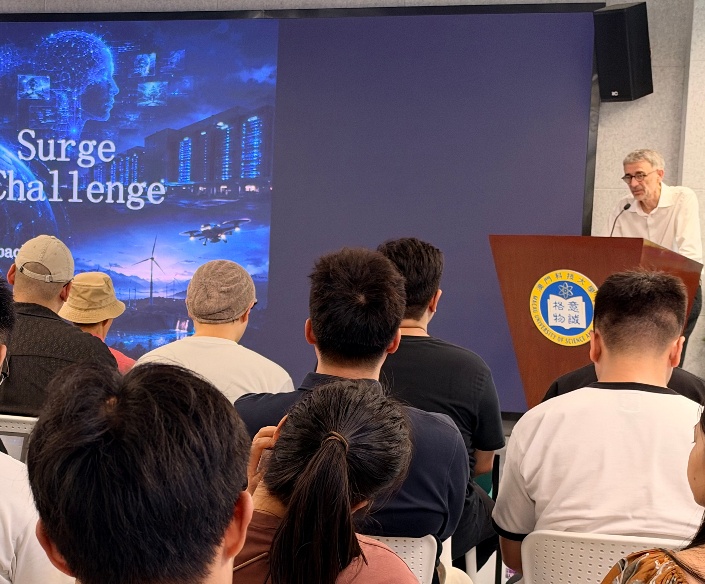
Dr. Stéphane Grumbach delivers the lecture
The lecture also reviewed how humanity has historically addressed rising complexity through improvements in information processing capabilities. From the invention of writing, printing technologies, statistics, and modelling methods to the emergence of computers, the Internet, and autonomous systems, advances in information technology have continuously transformed social organization and governance. Dr. Grumbach further discussed the phenomenon of a “contemporary singularity,” highlighting challenges such as planetary boundaries, cognitive limitations, and declining research productivity, while examining the implications for traditional governance models.
In addition, the lecture introduced emerging adaptive models driven by artificial intelligence and digital technologies, including automated scientific discovery, personalized medicine, AI-assisted governance, autonomous finance, and personalized legal services. Dr. Grumbach also addressed the dual impact of expanding information and computational capabilities: while they may help societies manage global interdependencies, they can simultaneously intensify systemic complexity. Achieving a balance between technological advancement and human values, he argued, will be a central challenge for future societal development.
The Distinguished Lecture Series aims to bring together leading international scholars to promote exchanges in frontier technologies and interdisciplinary research. The event encouraged students, faculty members, and the wider community to reflect on technological innovation, social governance, and sustainable development in the age of artificial intelligence from a global perspective, and to explore possible pathways toward a more resilient and intelligent future amid the continuing rise of global complexity.

