



The Faculty of Innovation Engineering of Macau University of Science and Technology held the third session of its Distinguished Lecture Series for the 2026/27 academic year on October 8, 2026. The lecture was delivered by Professor Zhang Honggang from the School of Computer Science and Engineering under the Faculty of Innovation Engineering, on the topic of “Agentic AI, NetGPT, AI-RAN and Future 6G.” The event attracted faculty members, students, and researchers who gathered to learn how artificial intelligence technologies are reshaping the future development of communication networks.
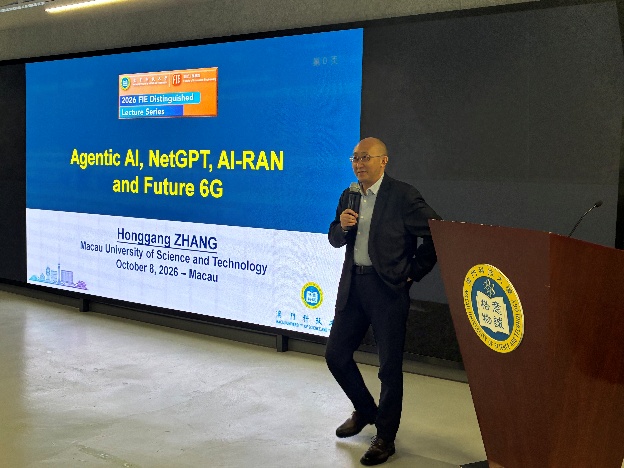
Professor Zhang Honggang delivering the lecture
During the lecture, Professor Zhang Honggang highlighted that with the rapid advancement of large language model technologies, artificial intelligence is no longer limited to generating text or answering questions. Instead, it is evolving into intelligent agents capable of autonomous reasoning, planning, and collaboration with other systems. He explained that the vast amount of data and services in future networks will be handled collaboratively by different AI systems, creating smarter and more convenient application experiences for society. According to Professor Zhang, future AI applications will require close coordination among cloud platforms, edge devices, and terminal devices, enabling different AI systems to work together effectively. Through the efficient integration of communication, computing, and data resources, a more intelligent and efficient next-generation network can be established.
Professor Zhang also introduced the concept of NetGPT, proposed by his research team. NetGPT can be regarded as a key platform for future AI networks, facilitating information exchange, task coordination, and collaborative execution among different AI systems, thereby improving overall operational efficiency. The lecture further discussed how multi-agent systems can cooperate through emerging technologies and new protocols, allowing AI tools to exchange information and divide tasks more effectively. This is expected to further enhance the capabilities and application scope of intelligent services.
Addressing the development of future 6G networks, Professor Zhang noted that artificial intelligence will become an integral component of next-generation communication systems. Beyond data transmission, future networks will possess capabilities for analysis, decision-making, and coordination, providing stronger support for applications such as smart cities, autonomous driving, and intelligent manufacturing.
During the lecture, Professor Zhang also presented the latest research achievements of his team in the integration of artificial intelligence and communications. These included AI model deployment in networks, collaborative AI system technologies, and methods for improving network operational efficiency, demonstrating the latest development trends in the field. Through this lecture, participants gained a deeper understanding of the emerging direction of AI-communications convergence and a more comprehensive appreciation of the application prospects of future 6G networks.

Group photo of participants

