



On June 18, 2026, Chen Minghai, a master's student from the School of Computer Science and Engineering, Faculty of Innovation Engineering at Macau University of Science and Technology (MUST), had his first-authored research paper titled "PhysDrape: Learning Explicit Forces and Collision Constraints for Physically Realistic Garment Draping" accepted by the European Conference on Computer Vision (ECCV 2026), a top international academic conference. Professor Li Jianqing, his supervisor, is the corresponding author of the paper. It is reported that the paper submission competition for this year's ECCV conference was extremely fierce, with an overall acceptance rate of only about 27%. For a master's student to publish a paper as the first author at this top international conference fully demonstrates his solid scientific research capabilities and excellent academic potential. This paper was jointly completed by MUST and institutions such as the Guangdong Institute of Intelligence Science and Technology.

Chen Minghai, Master's Student from the School of Computer Science and Engineering, Faculty of Innovation Engineering
In cutting-edge fields such as 3D virtual try-on, virtual digital humans, and the metaverse, making the wrinkles and draping effects of virtual garments look as natural as real fabrics has always been a technical challenge. Past solutions often struggle to achieve the best of both worlds: while traditional "pure physical computation" yields realistic results, the calculation process is very slow, making it difficult to meet the high-efficiency demands of modern applications. On the other hand, conventional "pure AI prediction," although fast, often relies on coherent video data to infer changes in clothing. This not only imposes extremely high data requirements but also frequently leads to "penetration" (collision errors)—an unrealistic phenomenon where clothing passes through the human body during complex movements. Therefore, ensuring generation speed while completely solving the penetration issue and achieving highly realistic garment effects remains a massive challenge in this field.
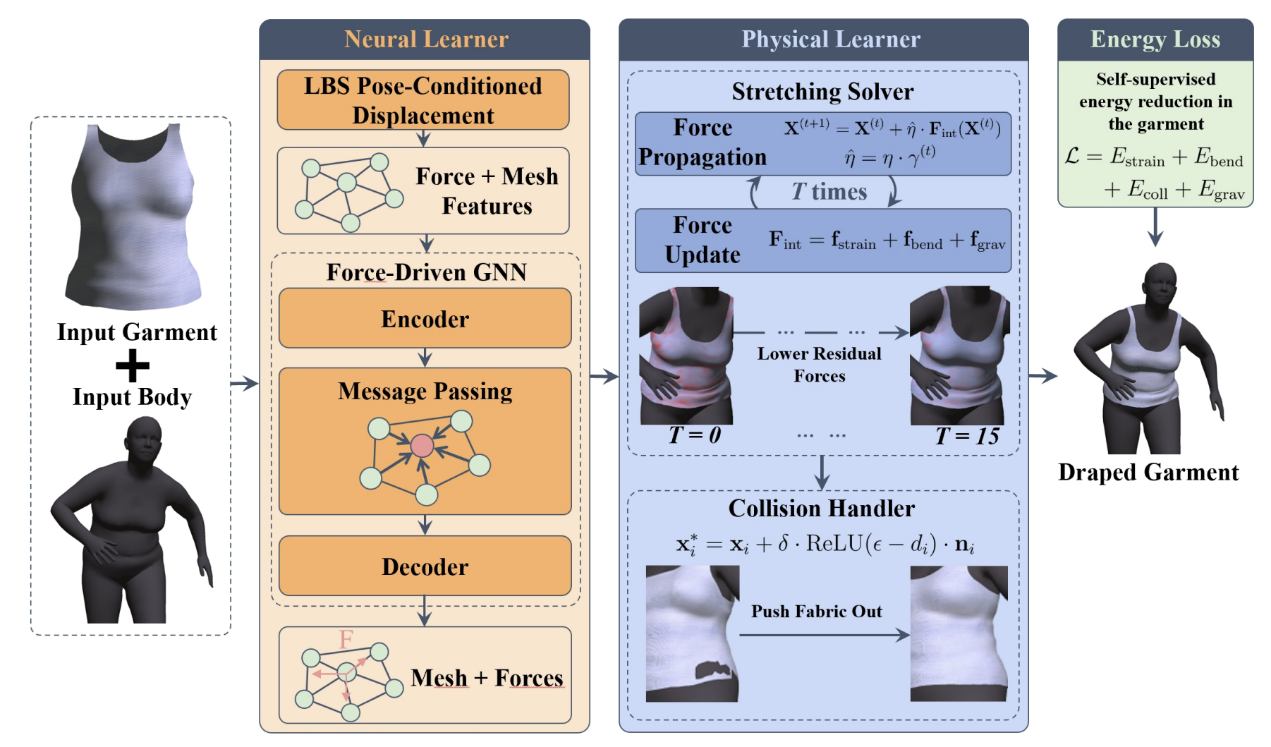
PhysDrape Training Framework
To break through this bottleneck, the research team proposed an innovative technology named "PhysDrape," successfully and ingeniously integrating "physical laws" with "deep learning". Unlike previous models that rely on continuous motion data, PhysDrape is a breakthrough "single-frame static model": it does not require coherent animation and can accurately calculate the physical state of clothing based solely on a static human posture. This technology consists of three tightly coordinated core components. First, a "force-driven neural network" analyzes the tension and gravity acting on the garment in the current posture to generate an initial clothing contour. Next, a "stretching solver" allows the details of the garment to unfold naturally according to the physical properties of real fabrics. Finally, a "collision handler" strictly monitors the boundaries between the garment and the human body; once an overlap is detected, it automatically corrects the garment to a reasonable position. This design, which perfectly blends "the efficiency of neural networks" with "the realism of physical computation," not only effectively solves the collision problem but also achieves ultimate realism for virtual garments in a single frame without requiring any animation data.
ECCV, along with CVPR and ICCV, are known as the three major top international academic conferences in the field of computer vision. They enjoy a highly prestigious reputation in both international academia and industry, representing the latest development directions and the highest research levels in the field. The acceptance of this paper by ECCV 2026 not only reflects the innovativeness and academic value of the research results but also demonstrates the significant achievements MUST has made in postgraduate cultivation, as well as its international competitiveness in the cutting-edge directions of computer vision. In the future, MUST will continue to promote the deep integration of data science, artificial intelligence, and cutting-edge interdisciplinary fields, contributing to the cultivation of more innovative scientific research talents with an international perspective.

