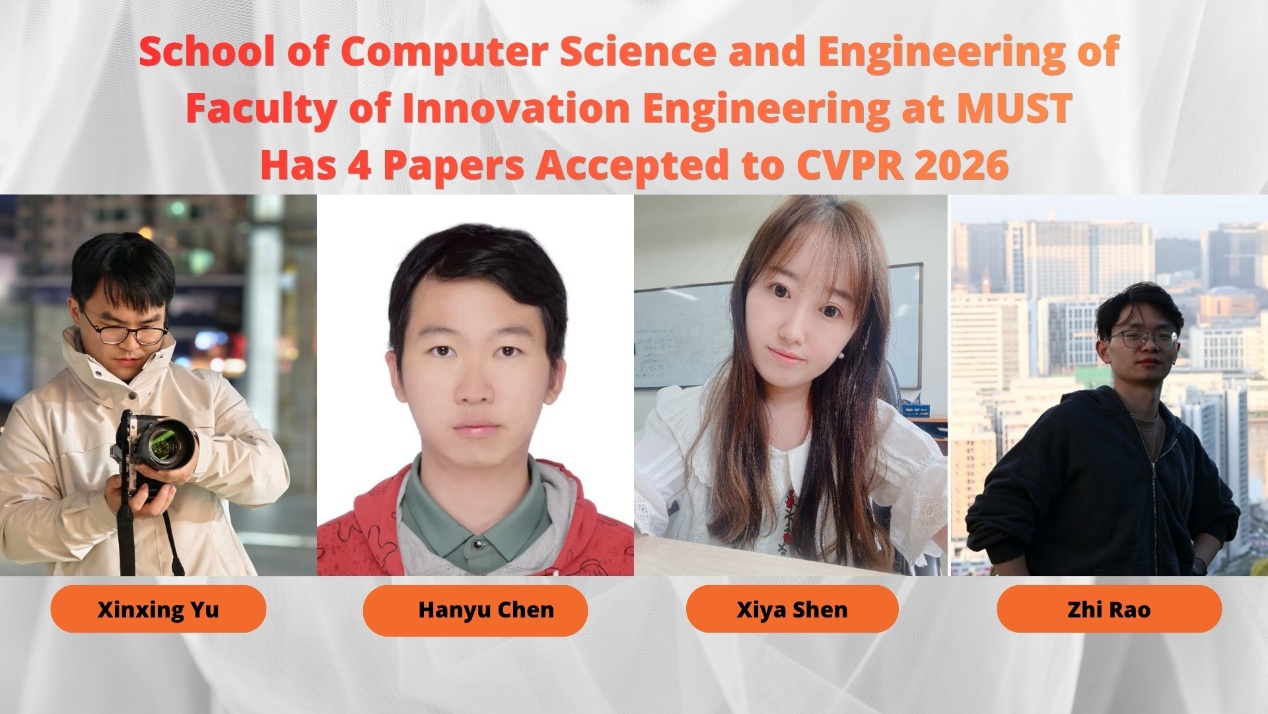



The acceptance results for CVPR 2026 (IEEE/CVF Conference on Computer Vision and Pattern Recognition), a premier international conference in computer vision and pattern recognition, have recently been announced. A total of four papers from the School of Computer Science and Engineering of Faculty of Innovation Engineering at Macau University of Science and Technology (MUST) were accepted, including three papers to the main conference and one paper to CVPR Findings. CVPR 2026 received 16,092 valid submissions, of which 4,090 were accepted to the main conference, corresponding to an acceptance rate of only 25.42%. In addition, 1,717 papers were selected for CVPR Findings.
Co-organized by IEEE and the Computer Vision Foundation (CVF), CVPR is one of the most influential top-tier conferences in computer vision and pattern recognition. It is also recognized by the China Computer Federation (CCF) as a Class A international conference in artificial intelligence, with broad impact across both academia and industry. The four papers accepted from MUST cover several frontier research areas, including self-supervised point cloud learning, controllable diffusion-based editing, medical image segmentation, and sign language translation. These achievements reflect the faculty's sustained efforts in 3D visual understanding, generative artificial intelligence, medical AI, and multimodal intelligence, and further demonstrate its overall strength in producing high-level research outcomes and contributing to the frontier development of AI.
In recent years, MUST has continued to advance the development of AI-related disciplines and has gradually established a multi-level talent cultivation system spanning undergraduate, master's, and doctoral education. Supported by multiple specialized research platforms, including laboratories in artificial intelligence and machine learning, the university has built an innovative environment integrating education, research, and application. The faculty has assembled a well-structured and internationally oriented teaching and research team, providing strong support for high-level talent cultivation and frontier research. With the continued deepening of disciplinary development, these efforts have also been recognized by major international ranking organizations. In the latest U.S. News 2025/2026 global subject rankings, MUST's artificial intelligence discipline ranked 88th worldwide. In the ShanghaiRanking 2025 Global Ranking of Academic Subjects, artificial intelligence at MUST was placed in the 151-200 band globally, highlighting the university's rising comprehensive strength and international influence in this field.
The acceptance of multiple papers to CVPR 2026 highlights the faculty's research accumulation and innovation capability in frontier areas such as artificial intelligence and computer vision, while also reflecting the phased achievements of its training model that promotes the coordinated development of research and teaching. Looking ahead, the university will continue to strengthen its disciplinary development in AI, expand high-level international cooperation, and further optimize its talent cultivation system based on existing research platforms, providing students with more advanced and systematic academic training and research practice opportunities, and promoting more high-quality research outcomes on the international academic stage.
Brief introductions to the four papers accepted by CVPR 2026 are as follows:
Paper Title: PointCSP: Cross-Sample Semantic Propagation and Stability Preservation in Self-Supervised Point Cloud Learning
Authors: Xinxing Yu, PhD student (first author); Associate Professor Yanyan Liang (advisor and corresponding author)Paper Title: Forensic-Friendly Image Manipulation via Controllable Latent Diffusion
Authors: Hanyu Chen, PhD student (first author); Assistant Professor Jinyu Tian (co-advisor); Professor Jianqing Li (advisor)Paper Title: AD-GBC: Anisotropic Granular-Ball Skip-Connection Refiner for UNet-Based Medical Image Segmentation
Authors: Xiya Shen, PhD student (first author); Professor Qinglin Zhao (advisor); Professor Li Feng (corresponding author)Paper Title: RVLF: A Reinforcing Vision-Language Framework for Gloss-Free Sign Language Translation (CVPR Findings)
Authors: Zhi Rao, PhD student (first author); Distinguished Professor Jun Wan (advisor and corresponding author)