


The National Finals of the 2026 Fourth Young Innovators Competition in Analytical Testing, jointly organized by the Journal of Instrumental Analysis and the Guangdong Association for Analysis and Testing, were held at Guangdong Technion–Israel Institute of Technology on 17–18 October 2026. Du Aolei, a first-year PhD student in Environmental Science and Engineering (2026 cohort) in the Department of Environmental Science and Engineering, Faculty of Innovation Engineering, Macau University of Science and Technology (MUST), won second prize in the Southern Regional Competition and third prize in the national finals with the project “Multi-Media Detection and Risk Assessment of Microplastics in Coastal Cities: Sources, Transport, and Sinks,” supervised by Assistant Professor Kai Zhang. These achievements demonstrate the innovation and research capabilities of MUST’s young researchers in environmental analytical testing and emerging contaminants.
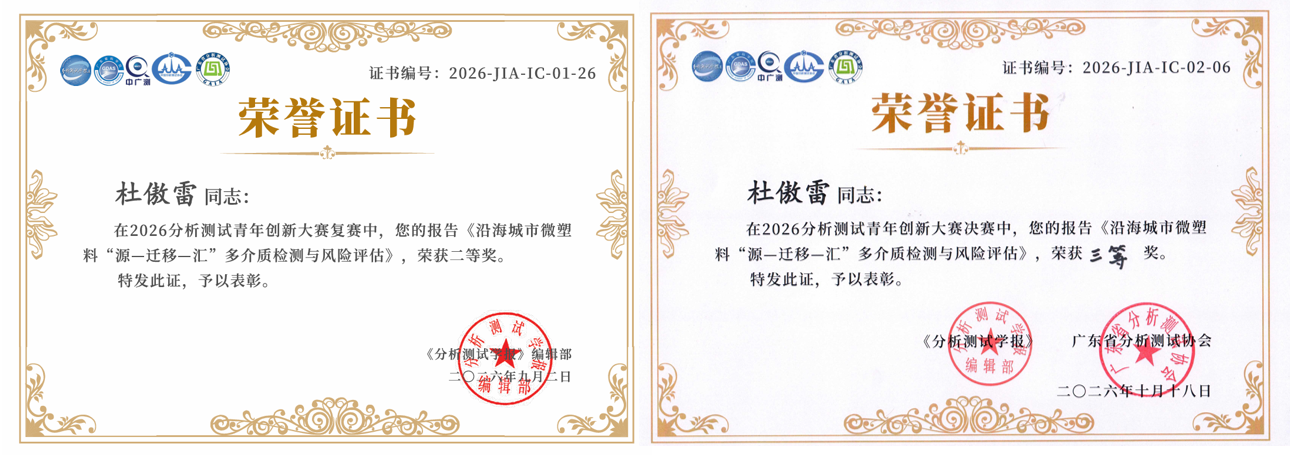
Award certificates from the 2026 Young Innovators Competition in Analytical Testing.
Launched in March 2026, the competition attracted 91 young researchers from more than 60 universities and research institutes across 27 provincial-level regions in China. Following the preliminary and regional rounds, 46 projects advanced to the national finals, including 16 finalists in the doctoral student category. Seven senior experts from institutions including Peking University, Sun Yat-sen University, Zhejiang University, South China University of Technology, and the Guangdong Academy of Sciences served as judges. They evaluated the projects for originality, academic merit, completeness, and potential applications. The competition aims to promote academic exchange among early-career researchers and the translation of innovative findings into practice.
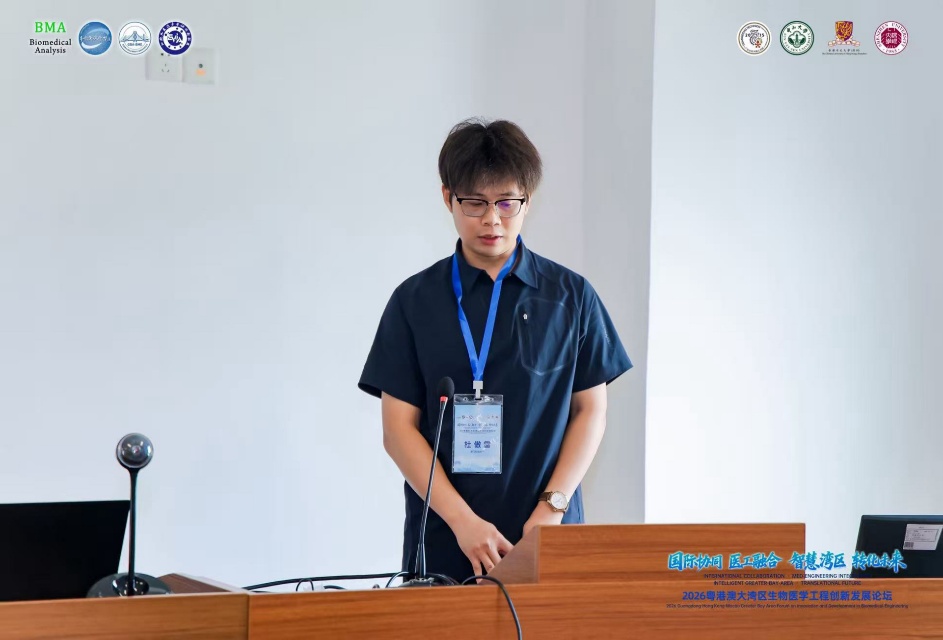
The national final competition.
Microplastics are plastic particles and fibers smaller than 5 mm. They are widespread in environmental media, difficult to remove, and associated with potential ecological and health risks, making them an emerging contaminant of global concern. Du Aolei’s project focuses on microplastic transport across environmental media and ecological risks in coastal cities. Using Macao as a representative study area, it develops an integrated “sources–transport–sinks” monitoring and assessment framework covering urban soils, stormwater drainage networks, wastewater treatment systems, and nearshore waters. The study employs analytical techniques including micro-Fourier transform infrared spectroscopy (μ-FTIR) to identify and quantify microplastics in different media, and evaluates pollution risks using the pollution load index, polymer hazard index, and potential ecological risk index. The project further improves a model for converting microplastic particle counts to mass concentrations, incorporating particle shape, size, and polymer density to estimate emission loads. OVD and inverse distance weighting interpolation in ArcGIS are used to visualize spatial pollution patterns and risks, helping identify potential hotspots. The findings may support the identification of pollution sources, key transport pathways, and high-risk polymers, while providing a reference for monitoring and risk assessment of emerging contaminants in other coastal cities.
Du Aolei enrolled in the Master of Environmental Science and Management at MUST in 2023 and continued to pursue a PhD in Environmental Science and Engineering in 2026. During his studies, he has conducted research on microplastics and emerging environmental contaminants. As first author, he has published research papers in the international journals Journal of Hazardous Materials (CAS Zone 1 TOP, JCR Q1, IF = 10.6) and Emerging Contaminants (CAS Zone 2, JCR Q1, IF = 8.2), building a strong foundation in scientific research. His success in this competition further reflects his abilities in environmental analytical testing, the integration of research methods, and the application of scientific findings.
This award reflects the Department of Environmental Science and Engineering’s commitment to developing young research talent and encouraging students to participate in high-level academic competitions. The Department will continue to support innovative research practice, strengthen connections between scientific research and real-world applications, and encourage young scholars to take part in academic exchanges and science and technology competitions in China and internationally, contributing to advances in scientific and technological innovation.

