


The Grand Final of the “2026 (21st) Cross-Strait and Hong Kong-Macao College Student Computer Innovation Competition”, co-hosted by the Computer Education Research Association of Chinese Universities (CERACU) and computer associations from various provinces and cities across the country, and undertaken by Leshan Vocational and Technical College, was held in Leshan, Sichuan from July 19 to 22, 2026. Following on-site exhibitions, expert reviews, and the final defense, the team of Mi Xinran, Xu Yidan, and Liu Xiangyu from the School of Computer Science and Engineering (SCSE), Faculty of Innovative Engineering, Macau University of Science and Technology (MUST), won the First Prize in the Undergraduate Group of the Computer Works Innovation Track with their project “Dual-Frequency Brain-Computer Interface Decoding System”. The first prize is the highest honor of the competition, and MUST is the only university from the Macao region to receive this distinction. This achievement demonstrates the innovative capability and research strength of MUST students in the frontier field of brain-computer interfaces, and reflects the SCSE’s success in integrating research with education and promoting learning through competition.
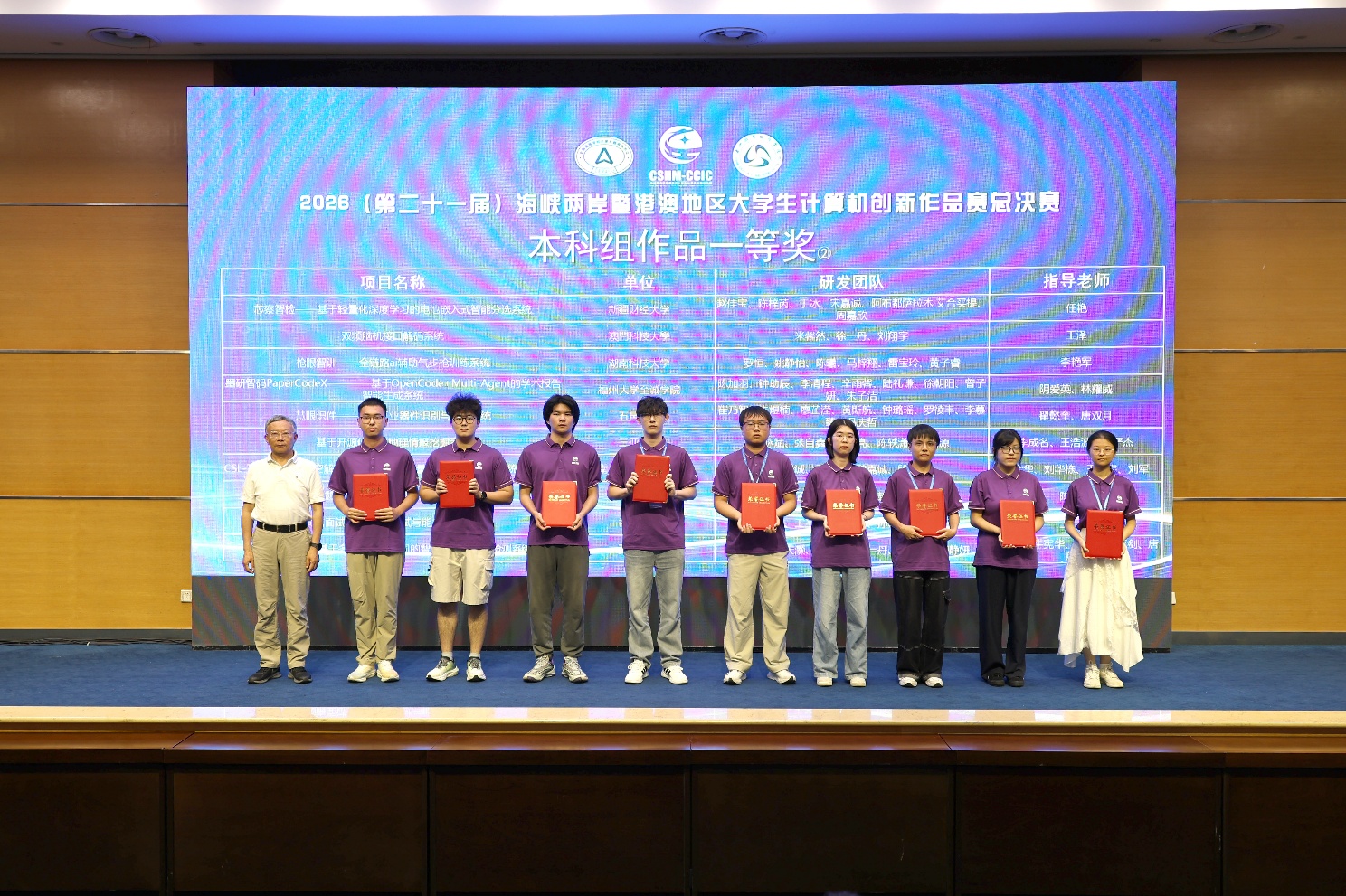
Mi Xinran (fourth from the right) received the award on behalf of the team.
The award-winning project was supervised by Assistant Professor Wang Ze from SCSE. The project employs brain-computer interface (BCI) technology based on dual-frequency steady-state visual evoked potentials (SSVEP). By generating more distinguishable EEG response patterns, the dual-frequency paradigm greatly expands the number of available commands of a BCI system. However, existing recognition algorithms generally rely on a large amount of user calibration data, which hinders their practical application. To address this challenge, the team proposed a cross-paradigm transfer learning canonical correlation analysis (CP-tlCCA) method at the algorithmic level, achieving “zero-calibration” dual-frequency EEG decoding without requiring any user calibration. Experiments across multiple dual-frequency paradigms show that the method significantly outperforms existing zero-calibration recognition methods, providing strong algorithmic support for truly “plug-and-play” BCI systems, with broad application prospects in intelligent interaction, medical rehabilitation, and other fields.
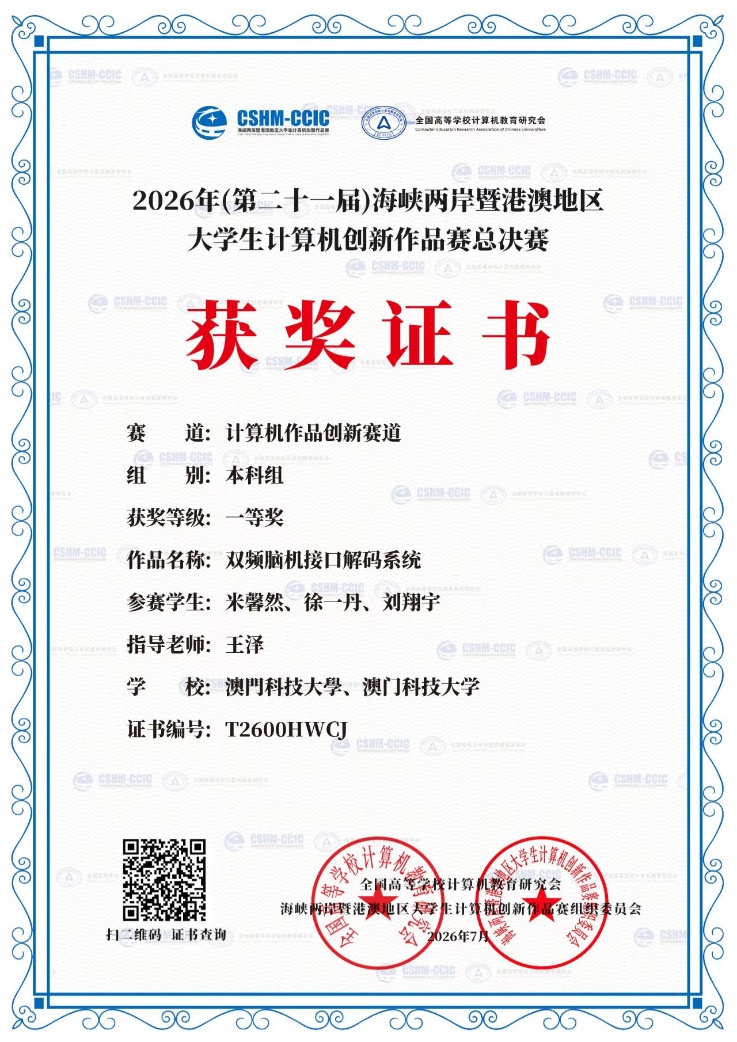
The award certificate of the MUST team.
The Cross-Strait and Hong Kong-Macao College Student Computer Innovation Competition (formerly the “Pan-Pearl River Delta+ College Student Computer Works Competition”) upholds the mission of “showcasing and exchange, strengthening friendship, mutual learning, and common progress”. Held consecutively for 21 editions since its establishment in 2006, the competition has been selected for many consecutive years for the National Collegiate Computing Competition Ranking List (a “white list” of competitions endorsed by the Ministry of Education of China), and is one of the most influential collegiate computer science and technology competitions across the Cross-Strait and Hong Kong-Macao region. This year’s competition underwent more than three months of selection across 29 provinces and regions nationwide, with outstanding projects advancing to the Grand Final covering frontier fields such as artificial intelligence and brain-computer interfaces, demonstrating both innovation and practicality. The competition finally awarded 20 First Prizes, 41 Second Prizes, and 57 Third Prizes in the Undergraduate Group, as well as 14 First Prizes, 26 Second Prizes, and 41 Third Prizes in the Higher Vocational College Group, in addition to special awards for Best Innovation and Best Practical Value.

