


A team from Macau University of Science and Technology (MUST) recently achieved second prize in the University Track of the 2025 "Wanfang Data Cup" AI Agent Competition with their project "Literature Analysis Assistant." The team—consisting of Associate Professor U Kin Tak and students Tan Hongqing, Pan Haodong, and Wang Bowen from the Faculty of Innovation Engineering—was the only winning team from Macao.
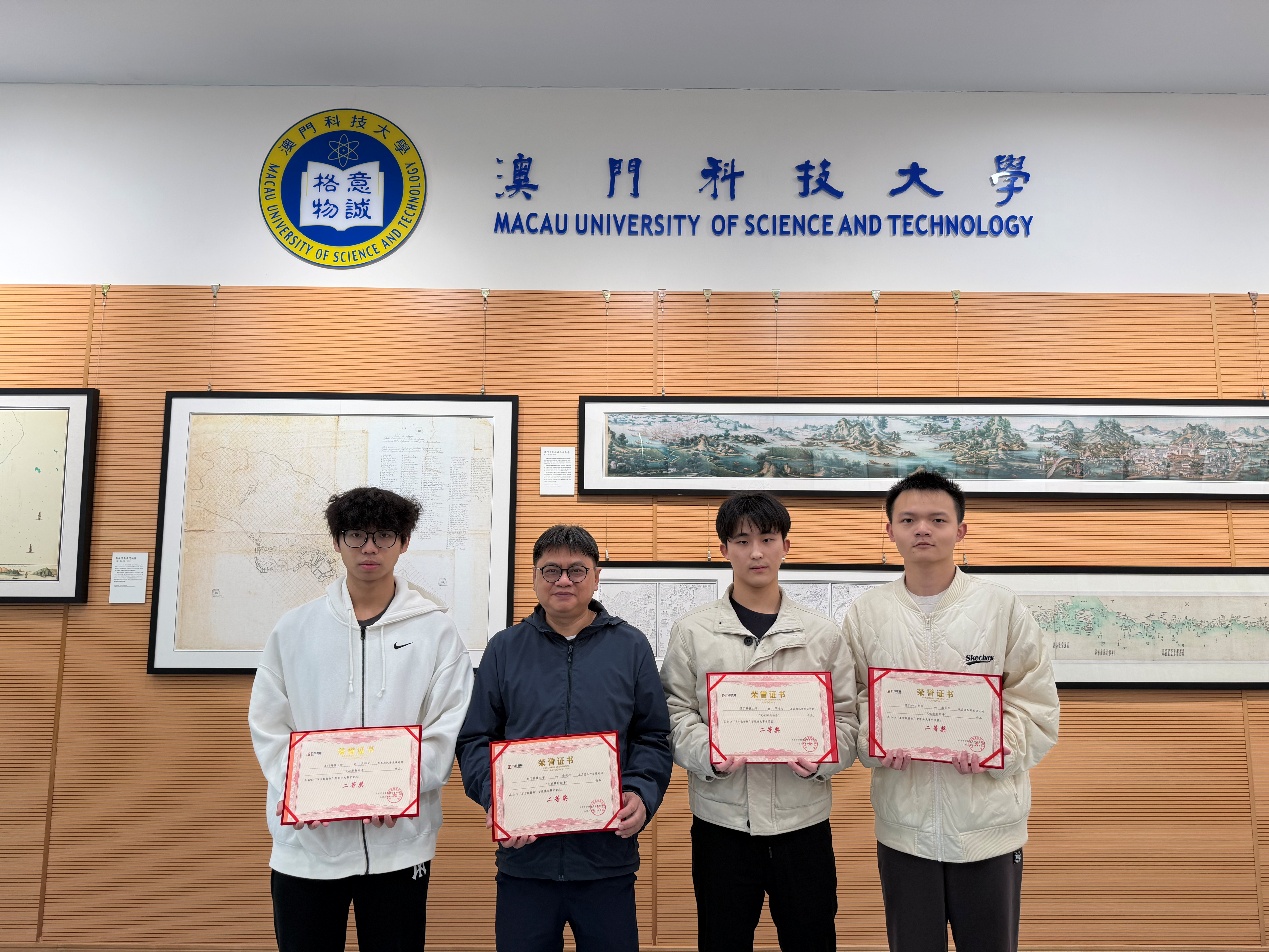
Award-Winning Team (From left to right: Wang Bowen, Associate Professor U Kin Tak, Tan Hongqing, Pan Haodong)
The "Wanfang Data Cup" AI Agent Competition is guided by authoritative institutions including Science and Technology Daily and the National Steering Committee for MLIS Degree Education, and organized by Beijing Wanfang Data Co., Ltd. Themed "AI Without Boundaries, Intelligent Innovation for the Future," the competition aims to inspire innovation, facilitate academic exchange on AI agent technologies, and promote the development of intelligent technology ecosystems.
The competition drew over 2,000 submissions from more than 170 universities, research institutions, and enterprises across 32 provinces, autonomous regions, and municipalities in mainland China, as well as Macao and Hong Kong SAR. After five months of rigorous competition and evaluation, 44 outstanding projects were selected: 1 Grand Prize, 6 First Prizes, 13 Second Prizes, and 24 Third Prizes. The MUST team stood out among numerous entries, fully demonstrating the innovation and application potential of their work.
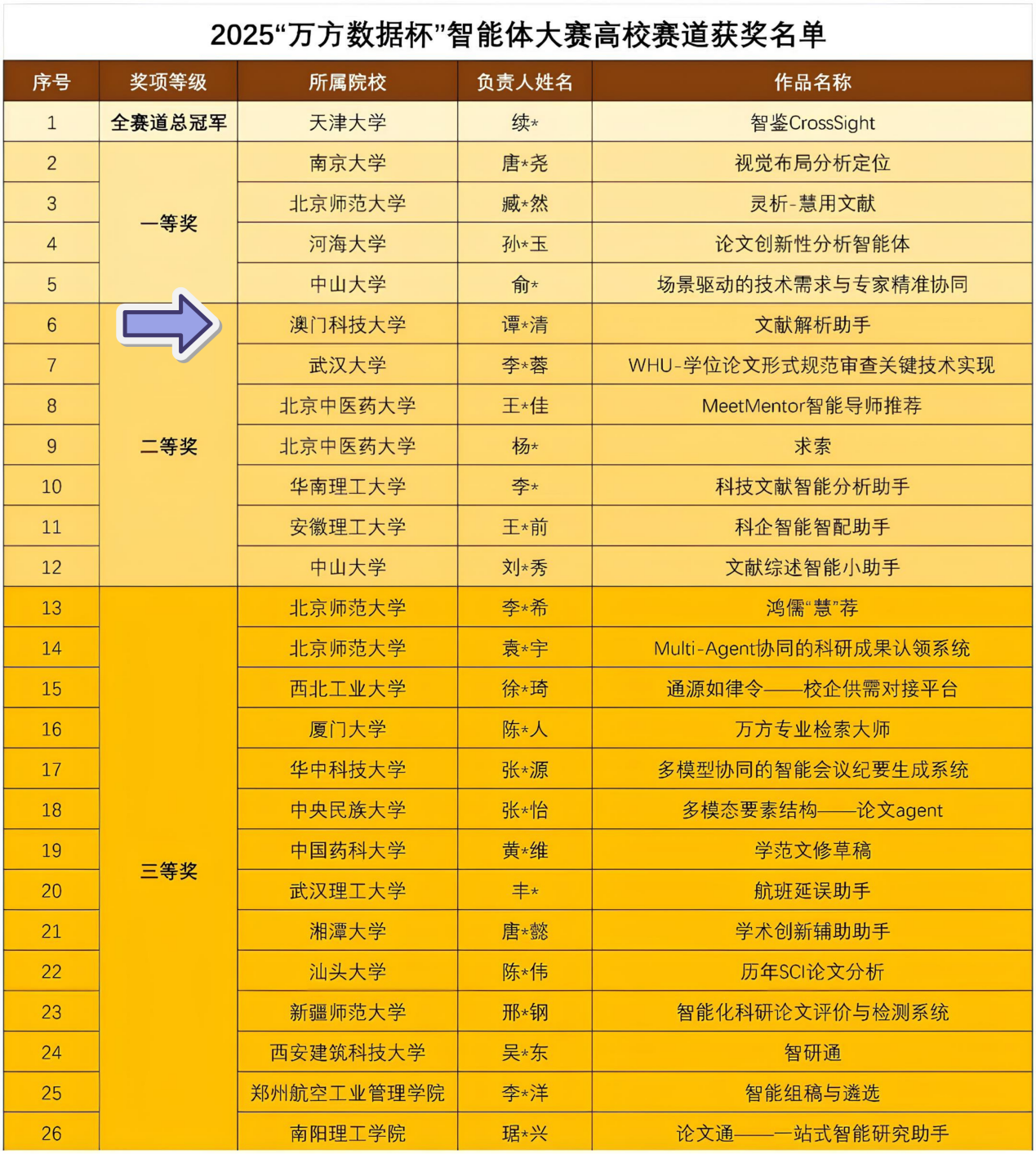
The Winning Project: "Literature Analysis Assistant"—A New Paradigm Empowering Academic Research
The MUST team's award-winning project "Literature Analysis Assistant" is an intelligent tool built on Large Language Models (LLM), designed to address a critical challenge in academic research: inefficient literature processing. It provides researchers with efficient, accurate, and visualized analytical support.
The core functions of the "Literature Analysis Assistant" include:
Intelligent Summarization and Q&A
Capable of performing deep analysis of individual papers, generating structured summaries, and providing intelligent answers to user questions.
Multi-Document Correlation Analysis
Supports batch processing of multiple papers, conducting cross-comparisons and synthesis, and displaying the intrinsic connections between documents through visualized diagrams.
Non-Text Element Parsing
Identifies and interprets non-textual information in literature, including images and formulas.
The assistant significantly reduces researchers' workload in literature search, reading, comprehension, and synthesis, thereby improving research efficiency and quality.

