



Recently, under the joint supervision of Assistant Professors Qingdong Ou and Songshan Zeng, the master student Zhiyuan Sun from the first cohort of Department of Materials Science and Engineering (DMSE) at Macau University of Science and Technology (MUST), has made significant progress in the field of flexible rehabilitation monitoring sensors. Drawing inspiration from the structural color mechanism of Steller’s jay feathers, the team developed a dual-mode sensor with optical and electrical feedback. This innovative device combines strain sensing and mechanochromic capabilities, offering a novel, precise, visual solution for rehabilitation monitoring. The findings were recently published in the high-impact journal Nano-Micro Letters (impact factor 36.3) under the title “Dual-Mode Sensor with Saturated Mechanochromic Structural Color Enhanced by Black Conductive Hydrogel for Interactive Rehabilitation Monitoring”.
Traditional rehabilitation training monitoring faces significant technical limitations. Assessments rely heavily on the subjective judgment of healthcare providers, lacking support from accurate quantitative data. Most existing electronic monitoring devices have a rigid structure, leading to mechanical mismatch with human skin that hinders long-term continuous monitoring. Furthermore, the majority of sensors depend solely on single-modal electrical signal feedback. These sensors require specialized equipment for data interpretation and cannot provide real-time, intuitive guidance on movement for trainees. To address this feedback gap, structural color materials with mechanochromic properties have been extensively studied. Among these materials, hydroxypropyl cellulose (HPC) is a preferred option due to its excellent biocompatibility and capacity to change color when exposed to external forces. However, HPC lacks intrinsic light-absorbing components. Its optical signals are highly susceptible to interference from background and stray light, resulting in low structural color contrast and poor visibility that undermines effective real-time visual guidance.
To resolve these critical challenges, this research team innovatively leveraged the structural color mechanism of Steller’s jay feathers. For the first time, the team proposed a strategy to enhance structural color with black conductive hydrogel. They successfully developed a flexible dual-mode sensor that offers both high structural color saturation and reliable electrical signal responsiveness. The striking cobalt blue of Steller’s jay feathers does not come from pigments. Instead, it is a classic case of structural coloration. Melanin in the bird’s underlying feather layer efficiently absorbs stray light, making the color reflected by specific structures purer and more vibrant. Precisely emulating this mechanism, the team designed a sensor with two core functional layers (Figure 1). The upper layer is an HPC-based structural color layer that generates structural colors via Bragg reflection and exhibits reversible color shifts when subjected to mechanical deformation. The lower layer is a flexible black conductive polymer hydrogel (CPH) developed by the team. It possesses both exceptional light absorption capability and outstanding strain sensing performance, with the two layers working in close synergy to enable the sensor’s dual-mode functionality.
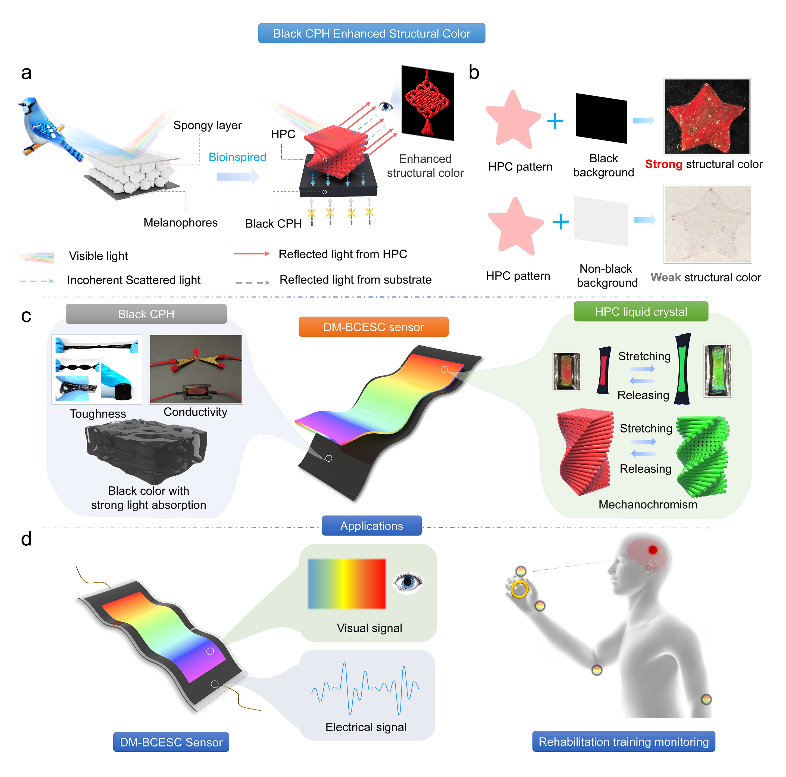
Figure 1. Schematic diagram of the dual-mode sensor’s design and applications
This bioinspired structural design offers remarkable advantages. The structural color of HPC on the black hydrogel substrate is significantly more vibrant, with much higher saturation and visual clarity, compared to its faint appearance on non-black substrates. This improvement stems from the lower-layer black hydrogel’s ability to efficiently absorb stray light and suppress background interference. Meanwhile, the hydrogel, developed through a specialized supramolecular strategy, offers both excellent stretchability and conductivity. It accommodates deformations induced by limb movements and serves as a sensing element to accurately capture movement-generated electrical signals. Ultimately, this synergistic interaction between the two layers allows the sensor to deliver “visual + digital” dual-mode feedback, effectively overcoming key limitations of traditional monitoring technologies.
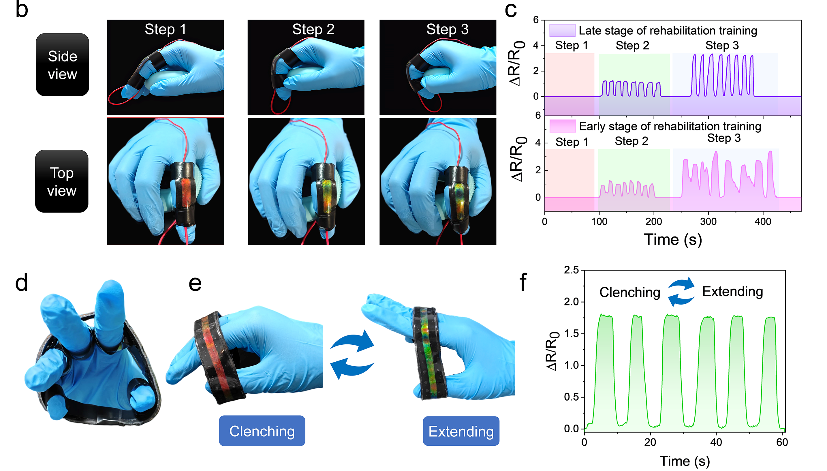
Figure 2. Applications of the dual-mode sensor in rehabilitation training monitoring
In real-world rehabilitation training scenarios, the sensor performs exceptionally well. When trainees carry out movements such as grip strength exercises, finger flexion-extension, and joint bending, the sensor displays a red, green, and blue color gradient that corresponds to the amplitude of movement. This offers an intuitive visual indicator of whether the movements are performed correctly. The simultaneously collected electrical signals accurately quantify parameters such as movement amplitude and frequency, providing an objective assessment framework for trainees (Figure 2). This integration of intuitive interaction and precise quantification not only boosts trainee engagement but also enhances the scientific rigor of rehabilitation assessments. To date, the sensor has been successfully used for monitoring joints at multiple sites and shows strong stability. It also holds significant promise in fields such as smart wearables and human-machine interaction.
The first authors of the paper are Zhiyuan Sun (MSc student) and Binhong Yu (postdoctoral researcher) from DMSE. The corresponding authors are Assistant Professors Qingdong Ou and Songshan Zeng of DMSE, and Associate Professor Zhandong Huang of Xi’an Jiaotong University. This research was supported by grants from the the Science and Technology Development Fund, Macau SAR (FDCT 0065/2023/AFJ, 0116/2022/A3, 00149/2022/A, 0046/2024/AFJ).
Link to the article: https://link.springer.com/article/10.1007/s40820-025-01963-2

